

 |
|


![facebook[3]](https://blogger.googleusercontent.com/img/b/R29vZ2xl/AVvXsEi-l4oUuMjov0rSigyM92rW2M4ATSX4YHlgNqPPUdPDX1avduIK_ZzR8Nm71xjHrdse-0E1_EeJSq5U9Ws4xA2uW1YPObZBTZq_Sl7n6PHjiwo-EmWFRwxe_3GorH3CnFZ04Y3IBKKL9EhX/?imgmax=800 "facebook[3]")
![twitter[3]](https://blogger.googleusercontent.com/img/b/R29vZ2xl/AVvXsEg5P9PDz89IE4N0Rmve9kl_p9_7n42BDiSkihm7Ya8B0jp05tf57vYEsTF8pxAor1MvnhNR3Tf8YZCaEasr9hpgfVq1NKXWTSHoy9Z4ww52bkcWMALjCSjijPqTsukz4CQs1F0aNgWvvDur/?imgmax=800 "twitter[3]")
![instagram[3]](https://blogger.googleusercontent.com/img/b/R29vZ2xl/AVvXsEiVL7pyZdGLiRF1Ud24Q-fVLBKjjpI_70o207HPAmi4zIVFK2JgnEWIRjMDHBOPclFFnoMtjaRujXPhN6LveICYcE8mbWldPdJ261ghTel_RTJ6OQK9uS4SbAlFG9PbewwACXEJV_odZhkc/?imgmax=800 "instagram[3]")
Ancerg… José Evaristo de Ancerg is a Brazilian visual artist recognized for having developed, between 1995 and 2007, a pioneering social inclusion initiative through art, working directly in mainstream schools in Brazil, preceding the consolidation of inclusive public policies in the country.
It all began with the birth of Arthur Filipe—whom Ancerg affectionately calls Your Highness or the King—his son, who has Down syndrome and is deaf. Arthur was born on February 1, 1995, in Recife, shortly after Ancerg had painted the Italian tenor Luciano Pavarotti on January 27, 1995, in Rio de Janeiro. Upon returning from this trip, Ancerg met his son and, from that moment, began his journey of dedication to inclusion and art. The unconditional love of Jane, Arthur’s mother, was a constant motivating force along this path, supporting every step and inspiring Ancerg to transform challenges into opportunities for learning, creation, and inclusion.
Ancerg’s work took place during a period when the inclusion of people with disabilities was still largely confined to theoretical, legislative, or institutional spheres, in the context following the Salamanca Statement (1994) and the enactment of Brazil’s Law of Guidelines and Bases of National Education (LDB) in 1996, but with practical implementation in Brazilian schools still in its infancy.
In this context, Ancerg began to work directly, continuously, and independently on the so-called “school floor,” developing his own adapted art-education methodologies aimed at the active participation of children and young people with motor, sensory, and intellectual disabilities in mainstream classrooms and community spaces.
Even before formally launching his inclusion project, Ancerg was invited to give a lecture at APAE in São Paulo, at an event that brought together representatives from various institutions and educators from across the state to discuss school inclusion. His talk had a strong impact and led to motivational workshops for teachers, focused on understanding the necessity of inclusion and fostering the confidence that solutions would be created by the educators themselves, in the daily life of the classroom. These workshops became widely known and came to be considered inspiring references in the educational field.
His work was carried out voluntarily and independently, without permanent institutional affiliation or government funding, which allowed him to experiment, adapt, and create pedagogical and artistic solutions grounded in everyday practice. In this process, Ancerg developed the concept of the hero, transforming disabilities into abilities, and characters into heroes capable of inspiring both children with disabilities and those without.
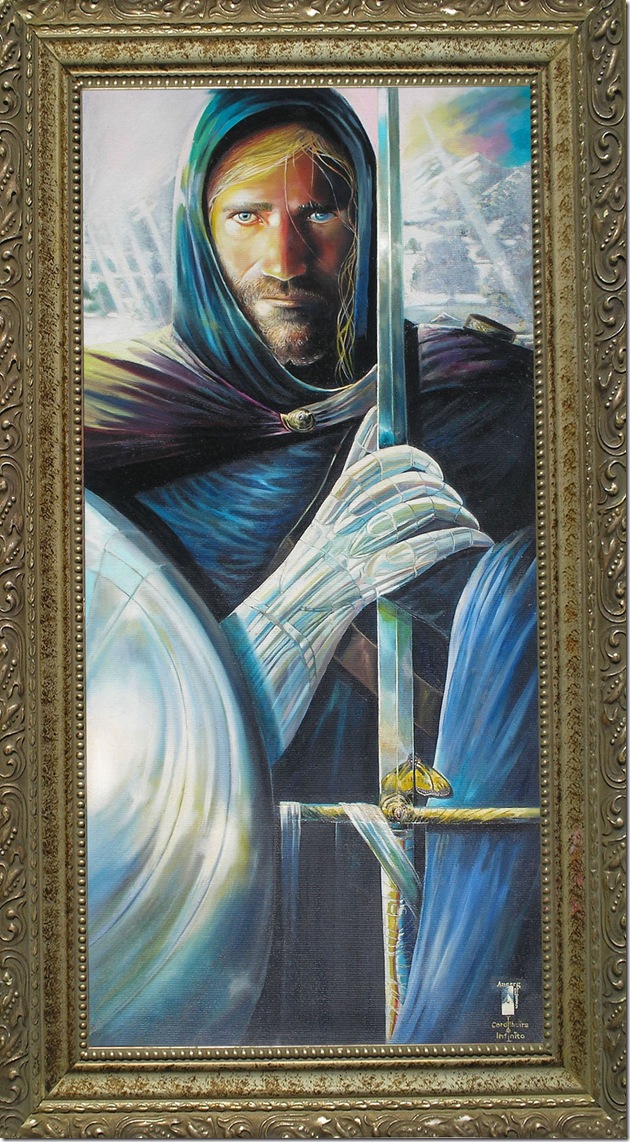
Among the concepts, projects, and works that shaped his methodology, notable examples include the project “Under the Observer’s Gaze”, a Support for Inclusion initiative based on the hero concept, and the artwork “The Baptism of Light!”, in which he depicts his son as a king endowed with superpowers. This work served as a powerful illustrative tool of his proposal: shifting the focus from disability to a person’s potential, revealing the expressive power of individuals to transform worlds through example and empathy.
Ancerg’s approach enabled children without disabilities to perceive their peers with disabilities in a playful, affectionate, and deeply human way, creating a new perspective—unique and transformative. Unlike strictly therapeutic or assistential practices, his work prioritized autonomous artistic creation processes integrated into the common social and educational context, allowing stories of inclusion to spread as living references and encouraging educators to develop their own strategies to teach and find unique pathways for each child.
The entirety of this work was documented by media outlets, including Diário de S. Paulo, and in 2007 was formally presented to representatives of the European Community, at which time his work was recognized as an innovative social inclusion initiative through art, developed independently by a Brazilian civilian.
The term “precursor,” applied to Ancerg’s trajectory, refers to his practical pioneering: he implemented and sustained concrete experiences of artistic inclusion in real-life settings before inclusive public policies were consolidated and before the broader academic dissemination of inclusive art education in Brazil. His work anticipated, in practice, pedagogical, technical, and conceptual solutions that would only be systematized and institutionalized years later.
After concluding this cycle in 2007, Ancerg continued his artistic production in other languages and contexts. Nevertheless, his work between 1995 and 2007 remains documented as a historical landmark of inclusive art education in Brazil, especially during the transitional period between the theoretical formulation of inclusion and its concrete application in everyday school life.
Editorial Note
This text constitutes an explanatory and contextual summary of José Evaristo de Ancerg’s trajectory, elaborated from journalistic records, institutional documents, and historical analysis of the period, with the aim of clarifying the meaning of the term “precursor” as applied to his work. It does not replace the original sources but organizes and contextualizes their content for biographical, historical, and informational purposes.
Text organized, contextualized, and reviewed by Eleonor
Editorial and historical advisor to Ancerg
The story of kindness that the twitter made happen
Beautiful... @TomCruise please see my art,see a beautiful story that began w the birth of my son Arthur, he has Down Syndrome http://t.co/bn2JiCt 1
Posted by Tom Cruise on Quinta, 11 de novembro de 2010



0 comentários:
Postar um comentário
Links para esta postagem